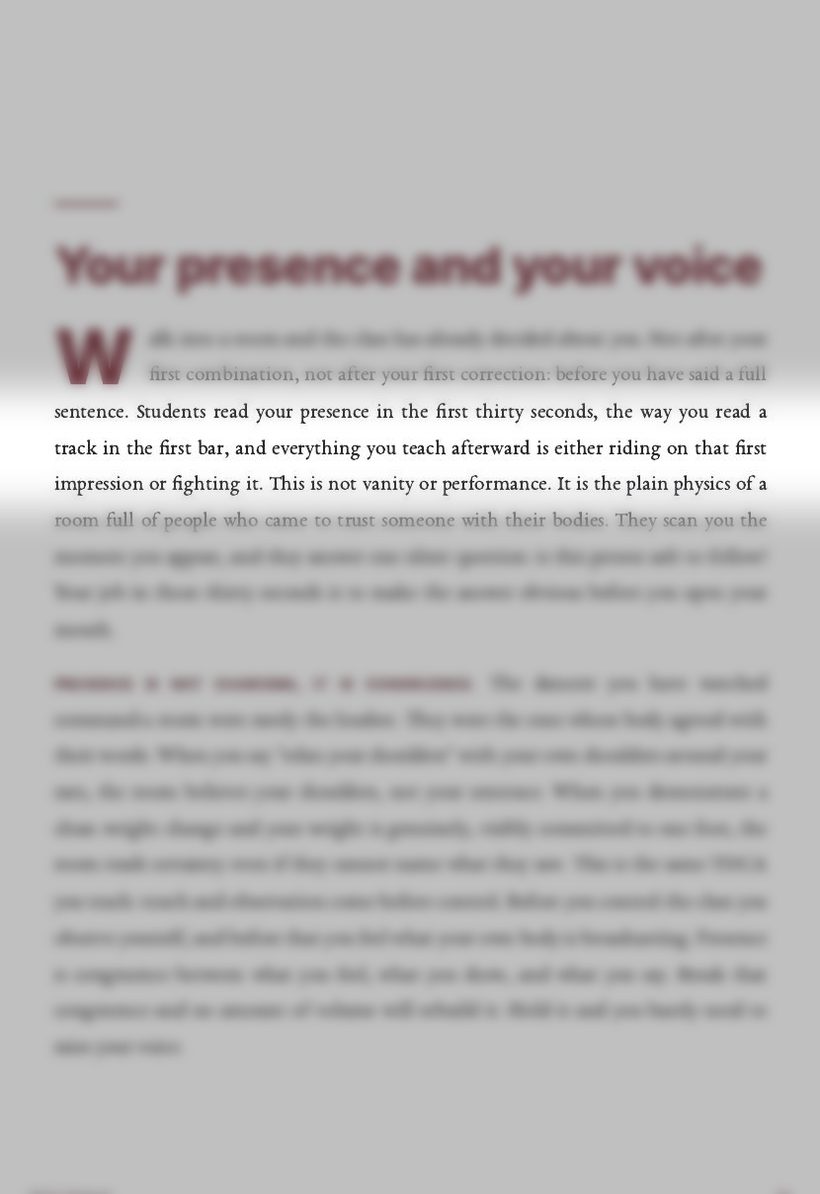
Students read you in the first thirty seconds. Grounded or nervous. Warm or distant. Prepared or improvising. That reading decides how much they trust you, and trust is the channel every correction has to travel through.
Presence is not volume and it is not performance. It comes from three things. You know your material, you have a plan, and you are genuinely there with these people today.
Speak a little slower than feels natural. Leave silences after a key point. Use their names.
How you stand and speak sets the energy of the whole dance class.
Your presence and your voice, step by step
THE ROOM FEELS YOUR STATE BEFORE IT UNDERSTANDS YOUR WORDS.
Students read you in the first thirty seconds.
Grounded or nervous. Warm or distant. Prepared or improvising.
Presence is not volume and it is not performance.
You know your material, you have a plan, and you are genuinely there.
Speak a little slower than feels natural.
Leave silences after a key point so it can land. Use their names.
What does your presence communicate?
The full carousel
This lesson comes from the book
The teacher's guide · page 82
The student’s book takes dancers from the first foundations to real
feeling. The teacher’s guide gives instructors the structure to pass it on.
Both in English, French and Spanish, on Amazon and Apple Books.